Children and Screens – French Reading Text and Exercises
This French B1-B2 worksheet explores the topic of children, screen exposure and the idea of a modern “digital pandemic”. It is based on a topical article about pediatricians Sylvie Dieu Osika and Eric Osika and their book L’Enfant-ecran.
Students read an authentic-style informational text, build key vocabulary, justify answers with evidence, practise grammar in context and discuss screen use through speaking and writing tasks.
The text invites learners to think critically about a very current issue: how screens affect young children’s attention, language, sleep, behavior and parent-child interactions. It gives teachers a rich theme for vocabulary work and classroom debate.
The resource is especially useful for intermediate and upper-intermediate learners because the topic is concrete, but the language encourages more precise expression: surexposition, prise de conscience, algorithmes, sevrage, captation de l’attention, troubles du comportement and more.
What Is Included?
Worksheet Preview
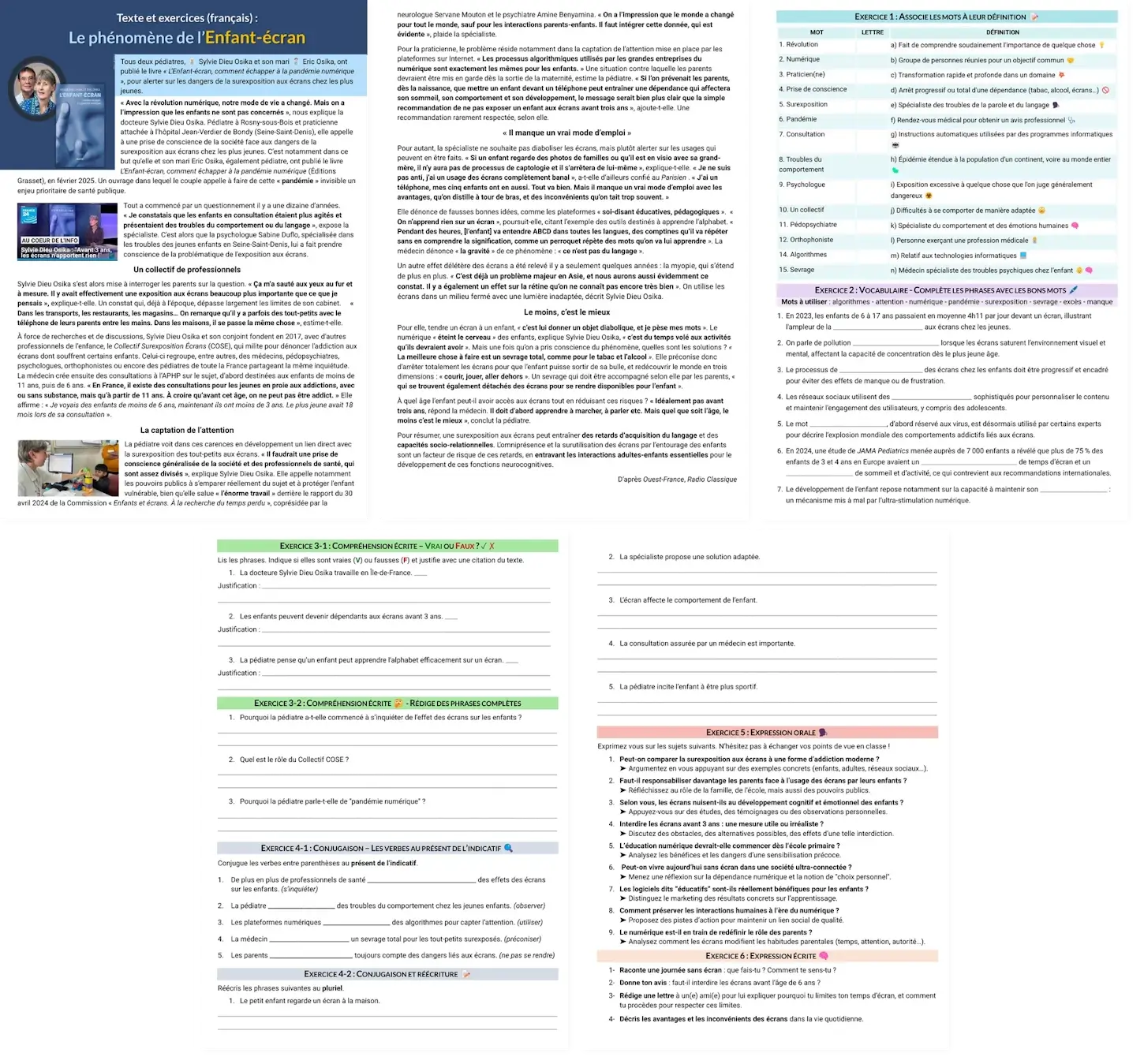
The preview shows the complete worksheet structure: the reading text, vocabulary matching, gap-fill vocabulary, true/false comprehension, written answers, present-tense conjugation, rewriting, oral expression and written expression.
Exercises In The Complete Version
- Exercise 1 – Match words to definitions: learners define key terms such as revolution, numerique, surexposition, pandemie, psychologue, algorithmes and sevrage.
- Exercise 2 – Vocabulary gap-fill: students reuse topic vocabulary in new sentences about screen exposure, attention, algorithms and digital habits.
- Exercise 3 – Written comprehension: true/false statements with textual justification, followed by open questions requiring full-sentence answers.
- Exercise 4 – Grammar: present-tense conjugation and rewriting sentences in the plural.
- Exercise 5 – Oral expression: debate prompts about screen addiction, parental responsibility, cognitive development and banning screens before age 3.
- Exercise 6 – Written expression: short writing prompts such as telling a screen-free day, writing a letter, or presenting advantages and disadvantages of screens.
Why This Worksheet Works Well
For learners, the topic is easy to relate to: phones, tablets, social media and video platforms are part of daily life. That makes the reading more meaningful and gives students a real reason to express opinions in French.
For teachers, the worksheet offers several possible entry points. It can be used as a reading comprehension lesson, a vocabulary sequence, a debate preparation activity, a grammar-in-context review or a writing assignment.
Downloads
Choose the version that best fits your lesson. Non-members can access two free PDF options, while premium members see the complete worksheet downloads.
Free Text-Only PDF
Download the 2-page reading text without exercises.
Free Watermarked Version – Text + 2 Exercises
Download the abridged 4-page PDF with visible watermark markings, vocabulary exercises and answer key.
Unlock The Complete Worksheet
Become a premium member to access the complete 7-page worksheet and editable Word version.
Frequently Asked Questions
What level is this worksheet for? ▼
It is designed for B1-B2 French learners, especially students who are ready to read a topical informational text and express opinions with supporting examples.
What is free? ▼
The text-only PDF is free, and the abridged watermarked PDF with 2 exercises and answer key is also free.
What is included in the premium version? ▼
The premium version includes the complete 7-page worksheet in PDF format and an editable DOCX version.
Can it be used for speaking practice? ▼
Yes. The complete version includes oral-expression prompts for classroom debate about children, screens, parental responsibility, addiction and early childhood development.