La marmite de Joha: A French Tale with Exercises 🍲
In a small oriental neighborhood, Joha borrows a copper cooking pot from his rich neighbor, and he returns it with a tiny pan inside. “Your pot had a baby last night!” he says, with a very serious face. The neighbor is delighted, you know, because a free pan is always a free pan.
A few days later, Joha borrows the pot again. And this time, well, it never comes back. When the neighbor knocks at his door, Joha is very sad: “Your pot is dead.” The neighbor is shocked: “A pot cannot die!” And Joha, with a smile: “If you believed it could have a baby, why can it not die? You have to be logical in life!” I love this tale. It is short, it is funny, and the students always laugh. And around this little story, we can work on almost every skill of the B1 level.
The tale and all the exercises, with the answer key
✨ What students practise
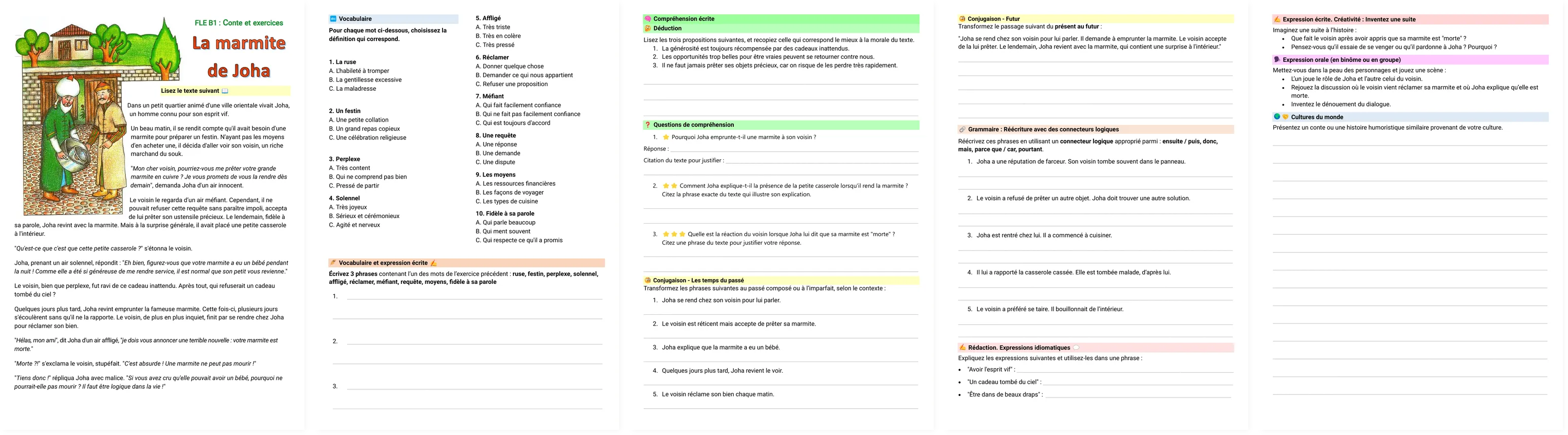
First, the reading: a short oriental tale with lively dialogue and a sharp moral. Then, well, a complete set of tasks that covers almost every skill of the B1 level: vocabulary with definitions, reading comprehension with quotes from the text, conjugation (passé composé, imparfait, futur), logical connectors, idiomatic expressions, and creative writing. In one document, you have almost a full lesson.
The worksheet ends with an oral role play (students become Joha and the neighbor) and an invitation to share a similar tale from their own culture. It is a great way to work on logic, argumentation and intercultural exchange, and the students, in my experience, they remember this lesson for a long time.
Read the tale: Joha borrows a pot, the pot has a baby, the pot dies.
Choose the moral, answer the comprehension questions with quotes from the text.
Conjugation (past, future), logical connectors, idiomatic expressions.
Role play the scene, invent an ending, share a tale from your own culture.
📚 What the worksheet contains
Nine sections, one tale, all the skills of the B1 level. Here is the overview:
Joha borrows a cooking pot, returns it with a tiny pan inside, then claims it died. A funny oriental tale with a sharp moral.
10 definitions to match, then 3 sentences to write with the words: ruse, festin, perplexe, solennel, affligé…
Choose the moral, then answer 3 questions with quotes from the text, from one star to three stars.
Transform sentences in passé composé or imparfait, and a whole passage from present to future.
Rewrite 5 sentences with logical connectors: ensuite, puis, donc, mais, car, pourtant.
Idiomatic expressions, a creative sequel to the tale, a role play, and a world culture exchange.
💬 The words and expressions of the tale
The main vocabulary and the three idiomatic expressions explained in the worksheet:
💎 Download the worksheet (Premium)
The tale and the nine sections of exercises, with the full answer key, in A4 and US Letter. The DOCX lets you adapt the text, the questions or the expressions to your group — which is practical, because some tales work better in one classroom than in another.
Preview: the tale and the nine sections of exercises
🎯 Recommended level, and other tales

❓ Frequently asked questions
📚 What level is this worksheet for?
Mainly B1: the text is short and accessible, but the nine sections of exercises (inference, connectors, idioms, creative writing, role play) stretch the language in all directions.
🗂️ What does the worksheet contain?
The tale, 10 vocabulary definitions, comprehension questions with quotes, conjugation (past and future), logical connectors, idiomatic expressions, creative writing, a role play and a world culture exchange.
🧠 What is the moral of the tale?
The worksheet proposes three morals, and students choose the best one. The expected answer is: “Opportunities too good to be true can turn against us.” But in class, I always let them defend the other answers too: it makes for a nice debate.
✅ Is there an answer key?
Yes, the full answer key is included, with the definitions, the comprehension answers, the conjugation and the connectors explained.
💎 Is the worksheet free?
No. The A4 and US Letter PDFs and the editable DOCX files are reserved for Premium members.