
Hachiko: Japan’s Most Famous Dog, Reading Comprehension Worksheet (Free PDF) 🗾
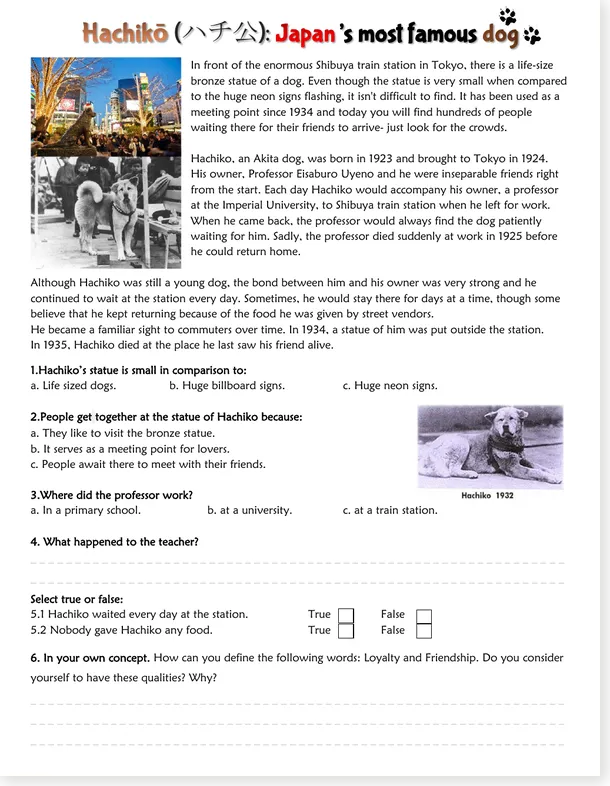
The true story of Hachikō, the Akita dog who waited for his owner at Shibuya station every day, even after the professor died in 1925. A narrative text of about 250 words, told in the past tense, followed by six tasks: three multiple-choice questions, one open answer, two true/false statements and a personal writing prompt on loyalty and friendship.
The PDFs in A4 and US Letter are free for everybody, and so is the answer key. The editable DOCX files are reserved for Premium members.
✨ What the students practise
The text is a real narrative in the past tense: born, brought, accompanied, waited, died. Students read for detail (dates, places, names), then answer in three different formats: choosing, judging true or false, and writing in their own words. The last task goes further: it asks them to define two values, loyalty and friendship, and to place themselves in the picture.
Read the true story of Hachiko, from 1923 to 1935, with the photos as support.
Answer the three multiple-choice questions on the statue, the meeting point and the professor.
Circle true or false, and answer one open question in a full sentence.
Define loyalty and friendship in your own words, and explain why they matter to you.
🗓️ The story in seven dates
The text follows a clear timeline, which makes it an excellent support for teaching the past tense:
❓ The six tasks
The statue compared to the neon signs, the reason people gather there, and the place where the professor worked.
Two statements to judge (the daily waiting, the food from vendors), and one question to answer in a full sentence: what happened to the teacher?
Define loyalty and friendship in your own words, then explain whether you have these qualities, and why.
📥 Download the worksheet
The PDFs in A4 and US Letter are free for everybody, with the answer key. The editable DOCX files are included in the Premium membership.
Preview: the story with its photos, and the six tasks below
📄 Free PDF – A4
The complete reading worksheet, free for everyone, ready to print.
📄 Free PDF – US Letter
The same worksheet sized 8.5 × 11 inches, also free.
✅ Answer key, free for everybody
📖 Open the answer key
- 1. c. Huge neon signs.
- 2. c. People await there to meet with their friends.
- 3. b. At a university.
- 4. He died suddenly at work in 1925, before he could return home.
- 5.1 True. 5.2 False: street vendors gave him food.
- 6. Model answer: loyalty means staying faithful to someone; friendship means being faithful to and supporting each other. I think I have these qualities because I help my friends, keep their secrets and stay by their side in difficult times.
✅ Answer key (PDF) – free for everybody
The corrected page, ready to project or print. No membership needed.
🎯 Recommended level, and more reading


❓ Frequently asked questions
🗂️ What does the worksheet contain?
A true-story text of about 250 words about Hachiko, with photos, followed by six tasks: three multiple-choice questions, one open answer, two true/false statements and a personal writing prompt on loyalty and friendship.
🎓 What level is it for?
A2-B1 in ESL classes: the narrative uses the past tense with simple structures. It also fits native readers in grades 4 to 7, and the last task stretches stronger writers.
🎁 Which files are free?
The PDFs in A4 and US Letter, and the answer key PDF, are free for everybody. The editable DOCX files are reserved for Premium members.
🔑 Is the answer key included?
Yes: the three multiple-choice answers, the true/false corrections, the open answer and a model sentence for the writing task. It is shown in the green accordion and downloadable as a free PDF.
🗣️ Can it lead to a discussion?
Yes: the text mentions that street vendors fed Hachiko, which opens the question of loyalty versus habit. It is a ready-made debate for the whole class.
📝 Can I adapt the text?
Yes: the Premium DOCX files let you shorten the story, change the questions or add vocabulary support for weaker groups.


