Road Accident: French Reading Comprehension Worksheet
A young pedestrian knocked down by a scooter, a driver who flees, bystanders who call the emergency services and a police investigation: this short, realistic story keeps learners hooked while they practise reading French.
The text and a first exercise are free to download. The complete worksheet with both exercises and a detailed answer key is reserved for Premium members, in A4 and US Letter PDFs plus an editable DOCX.
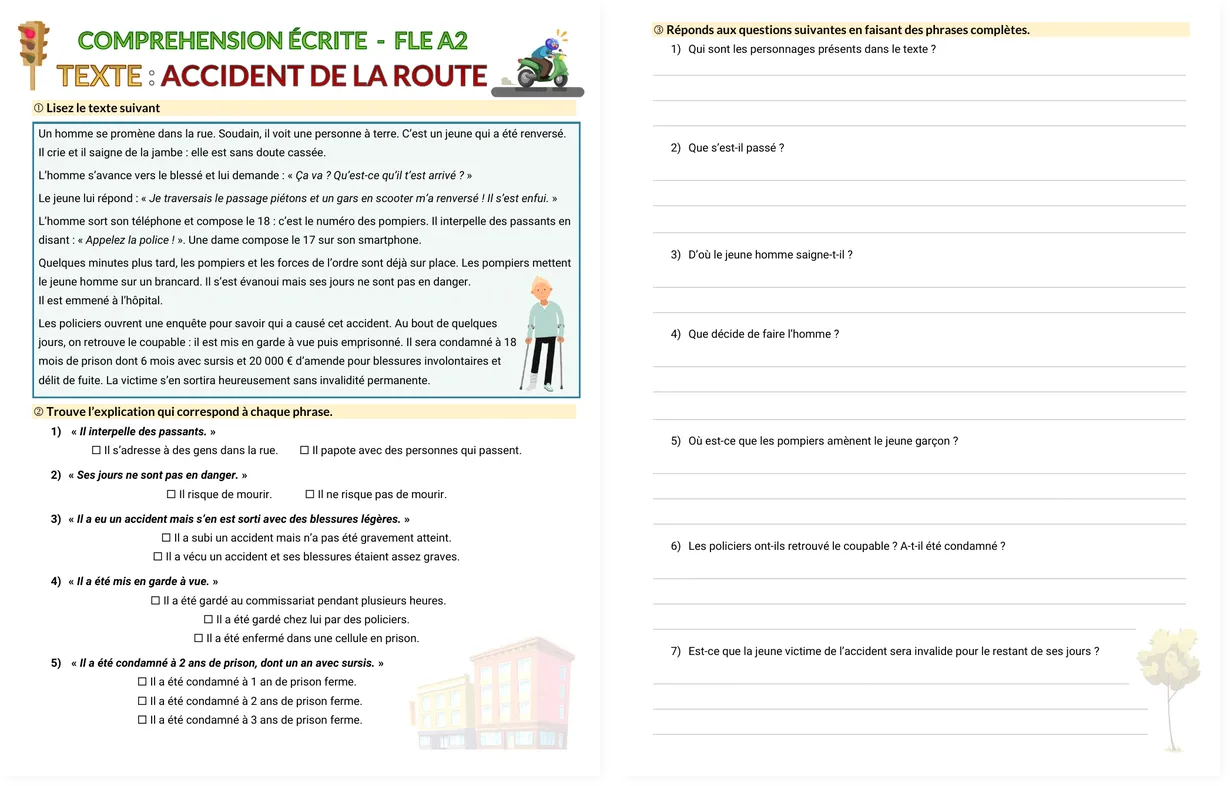
Page 1: text and multiple-choice task – Page 2: seven questions to answer in full sentences
What students practise
Students read a news-style narrative in three movements: the accident, the rescue and the investigation. Then they complete two tasks: match five key sentences from the text to the right explanation, and answer seven questions in complete French sentences.
Along the way, they also learn how an emergency works in France: the numbers 17 and 18, the firefighters, the police, and the vocabulary of accidents and justice.
Read the short story: the accident, the call for help, the rescue and the investigation.
Match five key sentences from the text to their correct explanation.
Answer seven comprehension questions in complete French sentences.
Use the detailed answer key in class or for self-study at home.
Key vocabulary from the story
Ten useful words and expressions to teach before or after the reading:
Read the story for free
The free one-page preview gives the complete story and the first exercise, so you can test the activity with your students before going Premium. It is available in both paper formats.
Free preview – A4 format
The full text and exercise 1, ready to print.
Free preview – US Letter format
The same one-page preview sized 8.5 x 11 inches.
Recommended level
Also available in the following French workbooks:
J’apprends le français!
Learning French Exercises for A2 to B1 Level
Choose the version that best suits your needs.


Prefer a digital version you can download instantly?
View the PDF version with answer keyFrequently asked questions
What level is this worksheet for?
Mainly A2: the text is short and clearly structured. The writing task also suits B1 and B2 students who need to practise full-sentence answers.
What is included in the free version?
The complete story and the first exercise on one watermarked page, in A4 and US Letter formats.
What is included in the Premium version?
The text, both exercises and the detailed answer key, in clean A4 and US Letter PDFs plus an editable DOCX.
Is there an answer key?
Yes. The Premium version includes model answers written in complete sentences, for class correction or self-study.
How can I extend the lesson orally?
Compare emergency numbers in different countries, or discuss the right reflexes when witnessing an accident. A natural bridge to a speaking activity.