Daily Life Sentences: Passé Composé, Futur Simple & Futur Proche ✍️
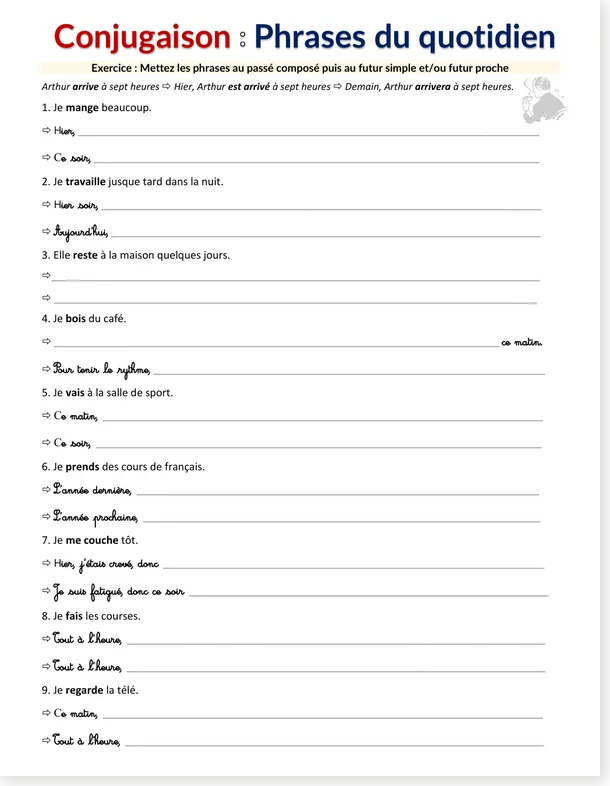
Nine everyday sentences in the present tense, and two transformations each: « Je mange beaucoup » becomes « Hier, j’ai beaucoup mangé » and « Ce soir, je mangerai beaucoup ». The same sentence, three time markers, three tenses — and the student learns to switch from one to another without thinking.
The exercise works on the three main tenses of the conversation at once: passé composé, futur simple and futur proche, with contextual markers (hier, ce matin, tout à l’heure, demain, l’année prochaine). The complete answer key is printed on the worksheet. The US Letter PDF with watermark is free for everybody; the clean PDFs and the editable DOCX files are for Premium members.
✨ What students practise
Three things, in order: 1) reading the present sentence and understanding the context; 2) choosing the right tense based on the time marker — hier triggers the passé composé, demain triggers the futur simple, ce soir can trigger the futur proche; 3) applying the agreement when needed (the movement verbs with être, the pronouns with reflexive verbs).
Nine sentences are enough to meet every case: regular verbs, irregular verbs, movement verbs with être, a reflexive verb (se coucher), and the double meaning of tout à l’heure — which can refer to the past or to the future, depending on the context. The answer key provides both futur simple and futur proche where both are possible.
Read the present sentence and understand the situation.
Transform into passé composé using the given time marker (hier, ce matin, l’année dernière).
Transform into futur simple or futur proche, depending on the marker (demain, ce soir, tout à l’heure).
Check the answer key: agreements, pronouns, and the choice between simple and near future.
📋 The 9 sentences, with both answers
Present on top, passé composé below in green, future below in gold. The answer key gives both futur simple and futur proche where both are possible — the teacher chooses which one to expect from the class.
🧠 The three tenses in three cards
Auxiliary avoir or être + past participle. For the movement verbs (aller, partir, venir, rester) and the reflexive verbs (se coucher), the participle agrees with the subject.
Infinitive + endings -ai, -as, -a, -ons, -ez, -ont. Used for plans, predictions, distant future. « Demain, je mangerai », « L’année prochaine, je prendrai des cours ».
Verb aller in the present + infinitive. Used for plans already decided, near future. « Ce soir, je vais manger », « Je vais aller à la salle de sport ».
Also available in the following French workbooks:
J’apprends le français!
Learning French Exercises for A2 to B1 Level
Choose the version that best suits your needs.


Prefer a digital version you can download instantly?
View the PDF version with answer key🎁 The free version, with watermark
The 9 sentences with both transformations, in US Letter, with our watermark. The answer key is included at the end.
🎁 Free PDF – US Letter, with watermark
The 9 sentences with the answer key, free for everyone.
🔓 Want the clean PDFs and the DOCX files?
Become a Premium member to unlock the clean A4 and US Letter versions, plus the editable Word files.
💎 The clean versions (Premium)
The same worksheet without watermark, in A4 and US Letter, plus the DOCX files to change the sentences, the time markers or the layout — useful to build your own versions for each class.
Preview: the 9 sentences and the corrigé
🎯 Recommended level, and the next steps


❓ Frequently asked questions
📚 What level is this worksheet for?
Mainly A2-B1: the sentences are simple, but combining passé composé, futur simple and futur proche in one exercise requires a solid grasp of all three tenses. Perfect for a B1 revision too.
🗂️ What does the worksheet contain?
Nine present-tense sentences, each to transform twice: once into the passé composé (with a past time marker), once into the futur simple or futur proche (with a future time marker). The complete answer key is included.
⏰ Which tenses are practised?
Three: the passé composé (with avoir and être), the futur simple, and the futur proche. The answer key provides both futures where both are possible.
🎁 Which version is free?
The US Letter PDF with watermark is free for everybody. The clean A4 and US Letter PDFs and the editable DOCX files are reserved for Premium members.
🔑 Is there an answer key?
Yes, the full corrigé is printed on the worksheet itself: all nine sentences conjugated in passé composé and in both future forms, with notes on the tricky cases (reflexive verbs, movement verbs, tout à l’heure).