Food Choices Worksheet: What Do You Like and Dislike? (Free PDF) 👍
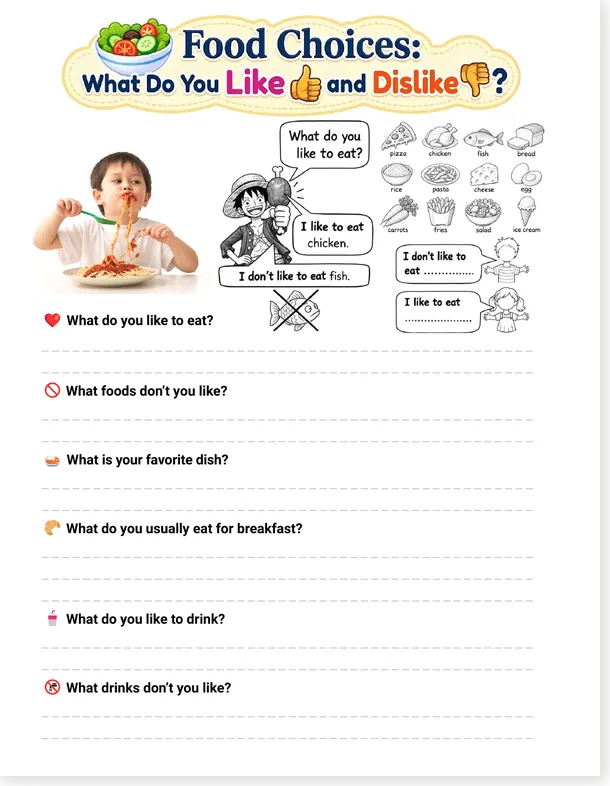
Twelve food pictures to name, two model speech bubbles to copy, and six personal questions to answer in full sentences: what you like to eat, what you don’t like, your favorite dish, your breakfast, and what you like or don’t like to drink. The student speaks about themselves, which is the fastest way to make the like / don’t like structure stick.
The US Letter PDF with watermark is free for everybody, and so is the page of example answers, placed just below the download buttons. The clean PDFs and the editable DOCX files are for Premium members.
✨ Four steps, from picture to sentence
The page is built like a ladder: the pictures give the words, the speech bubbles give the sentence pattern, the questions ask for full written answers, and the example answers show what a complete answer looks like. Nothing to memorize first: the student writes about their own plate.
Say the twelve foods of the word bank aloud: pizza, chicken, fish, bread, rice, pasta…
Use the model bubbles: « I like to eat… » and « I don’t like to eat… ».
Answer the six questions in full sentences on the writing lines.
Interview a partner, then report: « He likes… She doesn’t like… ».
🍽️ The word bank: twelve foods to name
Each picture of the word bank can go straight into a sentence. Drinks are left open on purpose: the student reuses drink words they already know (water, milk, juice, soda…).
📝 The six questions, and the pattern each one trains
Every question targets one sentence structure, so the six answers together cover the whole like / dislike system:
🎯 What the page trains
Affirmative and negative, with food nouns and with verbs: I like to eat, I don’t like to drink.
Twelve pictured foods plus the drink words the student already knows, all reused in real sentences.
Six answers on lined space: capital letter, list with commas and « and », final period.
📥 Download the worksheet
The watermarked US Letter PDF is free for everybody. The clean PDFs and the editable DOCX files, in A4 and US Letter, are included in the Premium membership. The example answers are free too, just below the buttons.
Preview: the word bank, the model bubbles and the six questions
🎁 Free PDF – US Letter, with watermark
The complete worksheet, free for everyone, ready to print.
🔓 Want the clean PDFs and the DOCX?
Become a Premium member to unlock the brand-free versions and the editable Word files.
✅ Example answers, free for everybody
Since every answer is personal, the example page is a model, not a correction: six complete handwritten sentences showing the patterns and the lists with « and ». No membership needed: open it, project it, print it.
📖 Open the example answers
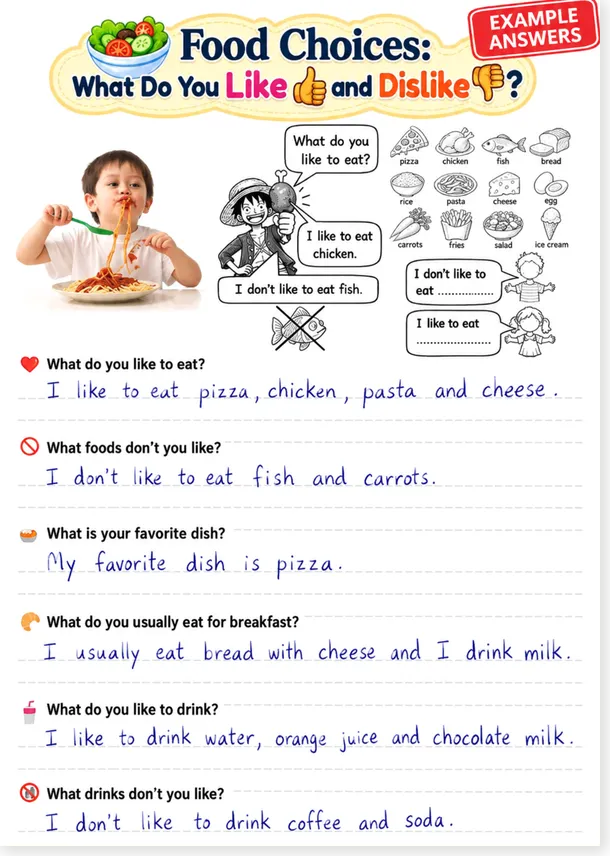
✅ Example answers (PDF) – free for everybody
The model answer page, ready to project or print. No membership needed.
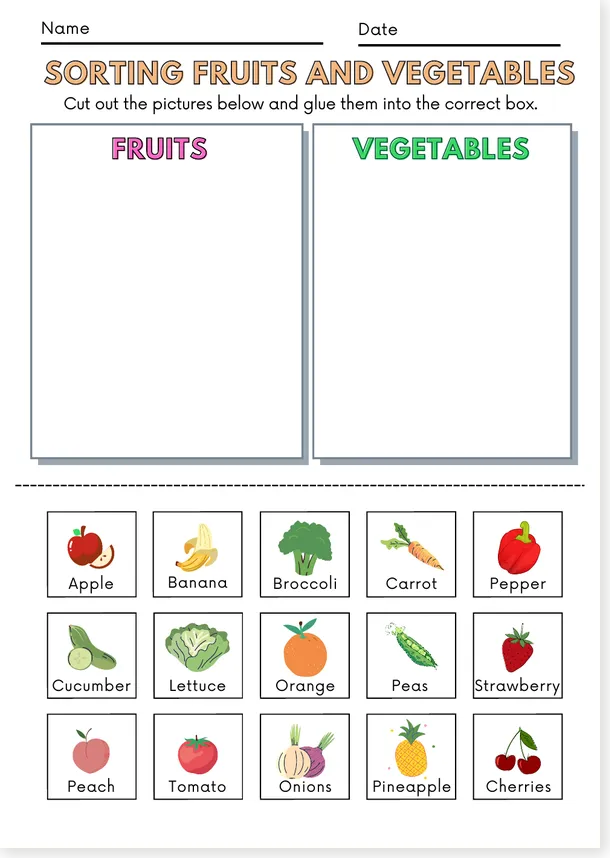
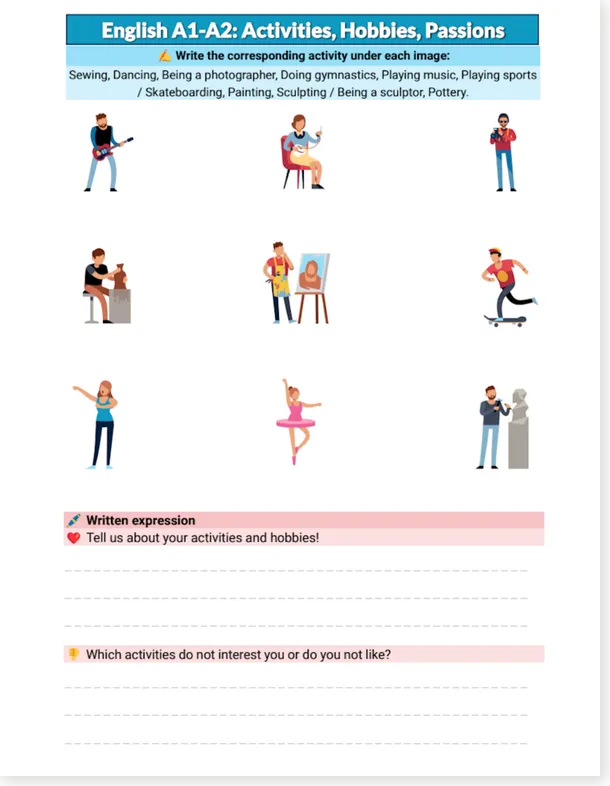
🎯 Recommended level, and more food and routine practice

❓ Frequently asked questions
🗂️ What does the worksheet contain?
A word bank of twelve pictured foods, two model speech bubbles (I like to eat… / I don’t like to eat…), and six personal questions with writing lines about food, breakfast and drinks.
🎓 What level is it for?
A1-A2 in ESL classes: the sentence patterns are given, so the student only chooses the words. It also works as sentence writing practice for native readers in grades 2 to 5.
✅ Is there an answer key?
Yes: a page of example answers with six complete model sentences. It is free for everybody and sits just below the download buttons, so every visitor can open or print it.
🎁 Which version is free?
The US Letter PDF with watermark and the example answers PDF are free for everybody. The clean A4 and US Letter PDFs and the editable DOCX files are reserved for Premium members.
🗣️ Can it be used for speaking?
Yes: the six questions are a ready-made interview. In pairs, students ask and answer, then report to the class with the third person: « He likes… She doesn’t like… ».
📝 Can I adapt the questions?
Yes: the DOCX files let you rewrite the questions, add lines, or replace foods in the word bank with dishes your students actually eat.