Canada Geese Worksheet: Trace the Flock, Read the Facts, Follow the Migration 🍁
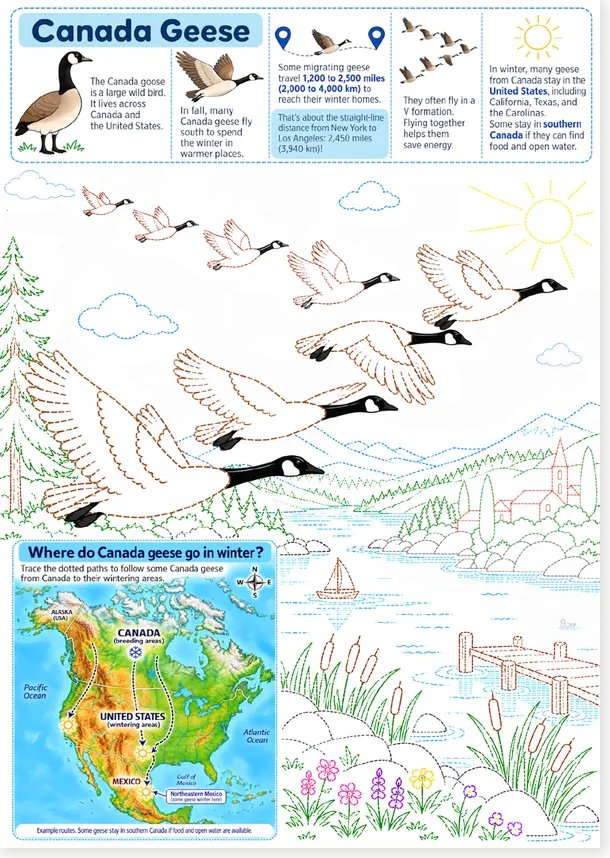
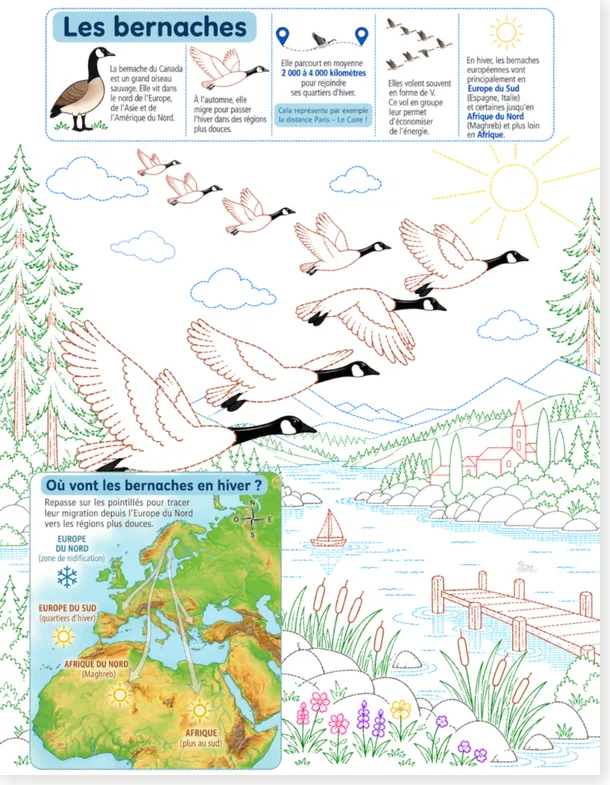
One full page about the Canada goose: five short fact panels at the top, a large flock of geese in dotted lines to trace and color over a complete landscape (pine trees, mountains, lake, dock, reeds and flowers), and a map of North America with dotted migration paths to follow. The child traces, colors, reads real facts with real numbers, and sees where the geese go in winter.
This is the English version of the Canada goose migration worksheet; a French version also exists on the site. The PDFs in A4 and US Letter are reserved for Premium members.
✨ Four tasks on one page
The page works on four levels at once: the hand traces the dotted geese and landscape, the pencil colors the scene, the eyes read five short fact panels with real distances in miles and kilometers, and the map at the bottom shows where the geese actually go in winter. One worksheet, four skills, no preparation needed.
Read the five fact panels at the top, alone or with an adult.
Follow the dotted lines: the geese, the trees, the clouds, the lake, the dock.
Color the flock and the whole landscape once the tracing is done.
On the map, trace the dotted migration paths from Canada to the wintering areas.
📖 The five fact panels
Short, true, and written in simple English. Each panel gives one idea the child can repeat in their own words:
🗺️ The map: where do Canada geese go in winter?
The bottom panel is a small map of North America with a compass rose (N, S, E, W). The instruction is simple: trace the dotted paths to follow some Canada geese from Canada to their wintering areas. Four reference points structure the map:
🎯 What the child gains
The dotted wings, bodies and landscape lines give long, varied strokes: curves for the wings, straight lines for the dock and the trees.
Five fact panels in simple English, with distances in miles and kilometers: reading practice that also teaches real facts.
A map of North America, a compass rose, breeding and wintering areas: the first vocabulary of migration, seen and traced, not just heard.
📥 Download the worksheet
Both printable formats are included in the Premium membership: the A4 PDF and the US Letter PDF.
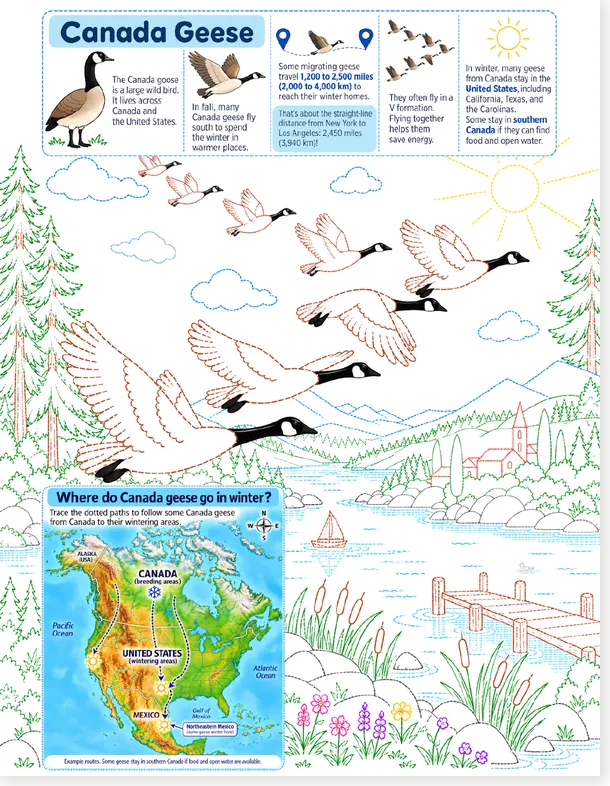
Preview: the fact panels, the flock to trace and the migration map
🎯 Recommended age, and more tracing
❓ Frequently asked questions
🗂️ What does the worksheet contain?
Five fact panels about the Canada goose, a large dotted scene of a flock flying over a landscape (trees, mountains, lake, dock, reeds, flowers) to trace and color, and a map of North America with dotted migration paths and a compass rose.
🌐 What language is it in?
English. A French version of the same theme also exists on the site, for bilingual classes or French lessons.
🎓 What age and grades?
Kindergarten to Grade 3: tracing and coloring for the youngest (ages 4 to 6, with the panels read aloud), and independent reading of the facts and the map from Grade 1.
🧠 What skills does it build?
Fine motor skills through tracing, reading comprehension with real numbers, geography (map, compass, breeding and wintering areas) and a first science lesson on migration and the V formation.
📄 Which files are available?
Two printable PDFs: A4 and US Letter (8.5 × 11 inches). Both are included in the Premium membership.
🔓 Is the worksheet free?
No. Both PDFs are reserved for Premium members.