French • High school • French Baccalaureate
Literary commentary practice exercises
Here are three documents to help students practise literary commentary at high school level, through texts by Honoré de Balzac, Albert Cohen and Denis Diderot. Each resource includes an excerpt, analysis prompts and methodological support to prepare for the French Baccalaureate. They should mainly be seen as guided exercises designed to help students gradually improve their analysis and synthesis skills. I have already used these resources in tutoring sessions.
🧠 Quick method reminder
Literary commentary goes beyond simply identifying techniques or spotting figures of speech. Its purpose is to reveal how a text works: to understand how the writing produces an effect on the reader and how it develops a vision of the world.
This approach is based on four key points:
- Movement: Follow the dynamics and progression of the text.
- Impression: Identify the atmosphere or emotion that emerges from the passage.
- Techniques: Analyse the stylistic choices that create this effect.
- Interpretation: Develop a personal reading, solidly supported by evidence from the text.
📋 Information about these exercises
| Level | High school: Grade 10, Grade 11 and French Baccalaureate preparation. |
|---|---|
| Activity type | Literary commentary practice, guided analysis, outline, introduction, conclusion and answer-key support. |
| Authors studied | Balzac, Albert Cohen and Diderot. |
| Objective | To help students move from identifying techniques to developing a real interpretation of the text. |
| Formats | Free or partly free PDFs depending on the resource, plus premium clean PDF and/or editable DOCX versions. |
🔍 General content ▼
This page brings together three literary commentary practice worksheets. The exercises can be used in class, as homework, during a methodology lesson or for revision before an assessment.
-
Varied literary texts A realist novel, a satirical novel passage and a philosophical reflection on ruins.
-
Step-by-step support Students are guided towards the main issue, the outline, the analysis and the written response.
-
Answer keys and analysis prompts The documents help students understand what is expected in a literary commentary.
🎯 Learning objectives ▼
Identify the key issues in the passage and follow the progression of the text.
Connect literary techniques to a clear interpretation, instead of simply listing figures of speech.
Organise ideas into coherent sections before writing the commentary.
Practise the introduction, transitions, analytical paragraphs and conclusion.
👥 Recommended audience ▼
These resources are especially suitable for:
💡 How to use these worksheets ▼
1. Literary commentary practice: Le Médecin de campagne, by Balzac
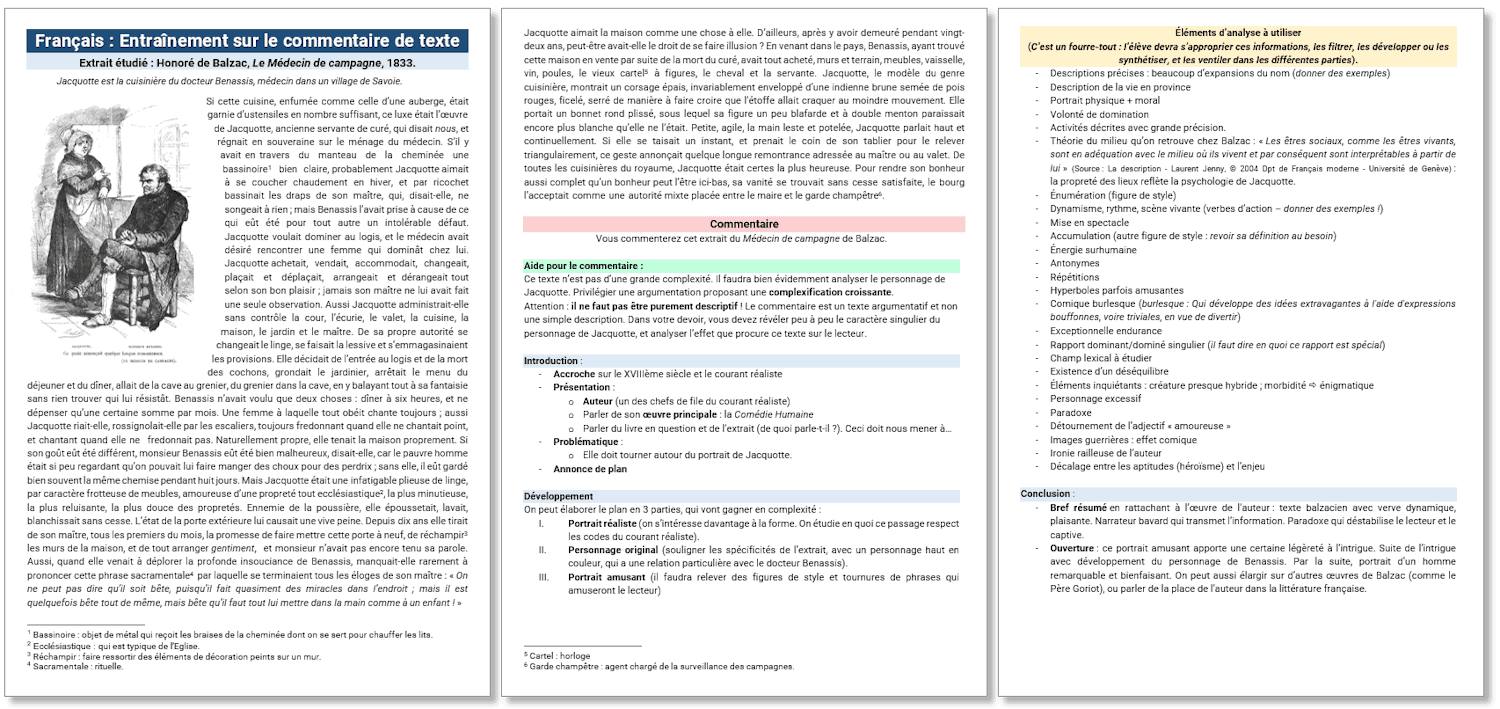
In this exercise, inspired by the 2020 French Baccalaureate, you will find a text by Balzac taken from Le Médecin de campagne (1833). The passage is especially useful for working on portrait writing, description and the construction of a novelist’s perspective.
📎 Balzac worksheet content ▼
-
Literary excerpt A passage from Balzac’s Le Médecin de campagne, focused on the portrait of Jacquotte.
-
Commentary support Introduction structure, suggested outline, analysis points and help for writing the conclusion.
-
Answer-key elements Guidance to help students build their literary commentary.
📥 Download the PDF – Balzac
Literary commentary worksheet on Le Médecin de campagne, ready to print.
🔒 Editable DOCX version – Balzac
The editable Word version is reserved for premium members.
2. Literary commentary practice: Belle du Seigneur, by Albert Cohen
In this exercise, inspired by the 2020 French Baccalaureate, you will find a text by Albert Cohen taken from Belle du Seigneur (1968). The passage offers a grotesque portrait of Adrien Deume and makes it possible to work on irony, satire and character construction.
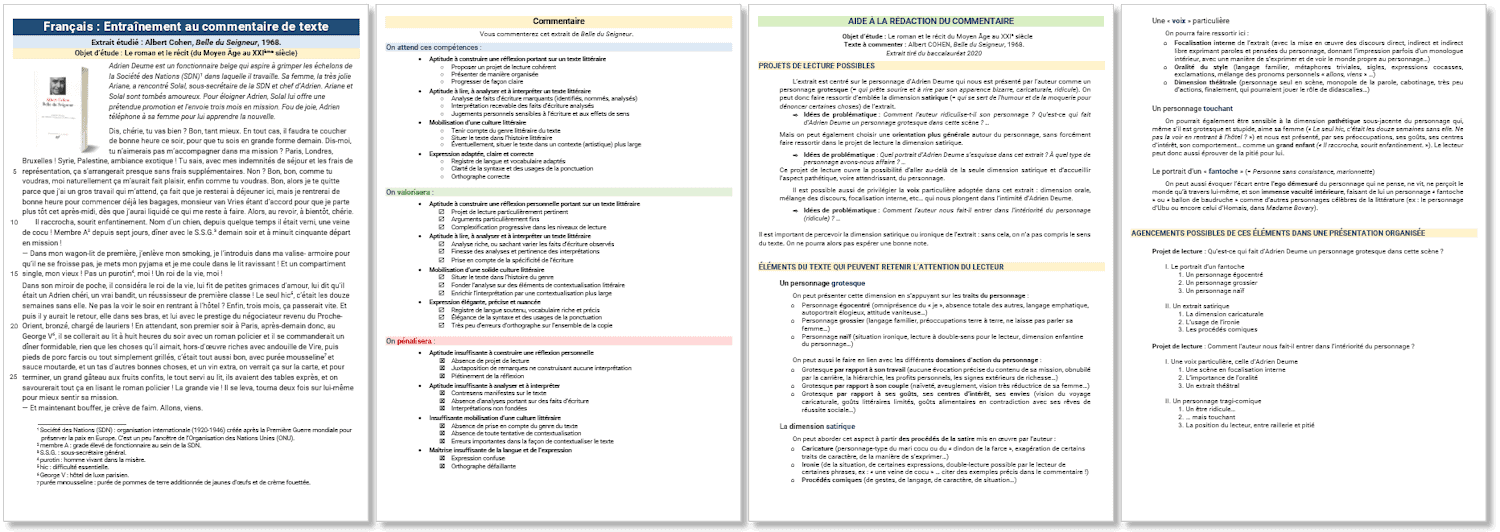
📎 Albert Cohen worksheet content ▼
-
Literary excerpt A passage from Belle du Seigneur focused on the grotesque portrait of Adrien Deume.
-
Satire and irony A useful resource for analysing comedy, caricature and the narrator’s critical perspective.
-
Methodological support Assessment expectations, possible interpretations, analysis points and suggested outlines.
🔒 Download the exercise – Albert Cohen
The PDF and editable DOCX version of the worksheet on Belle du Seigneur are reserved for premium members.
3. Additional exercise: Diderot, Salon de 1767 – ruins and meditation on time
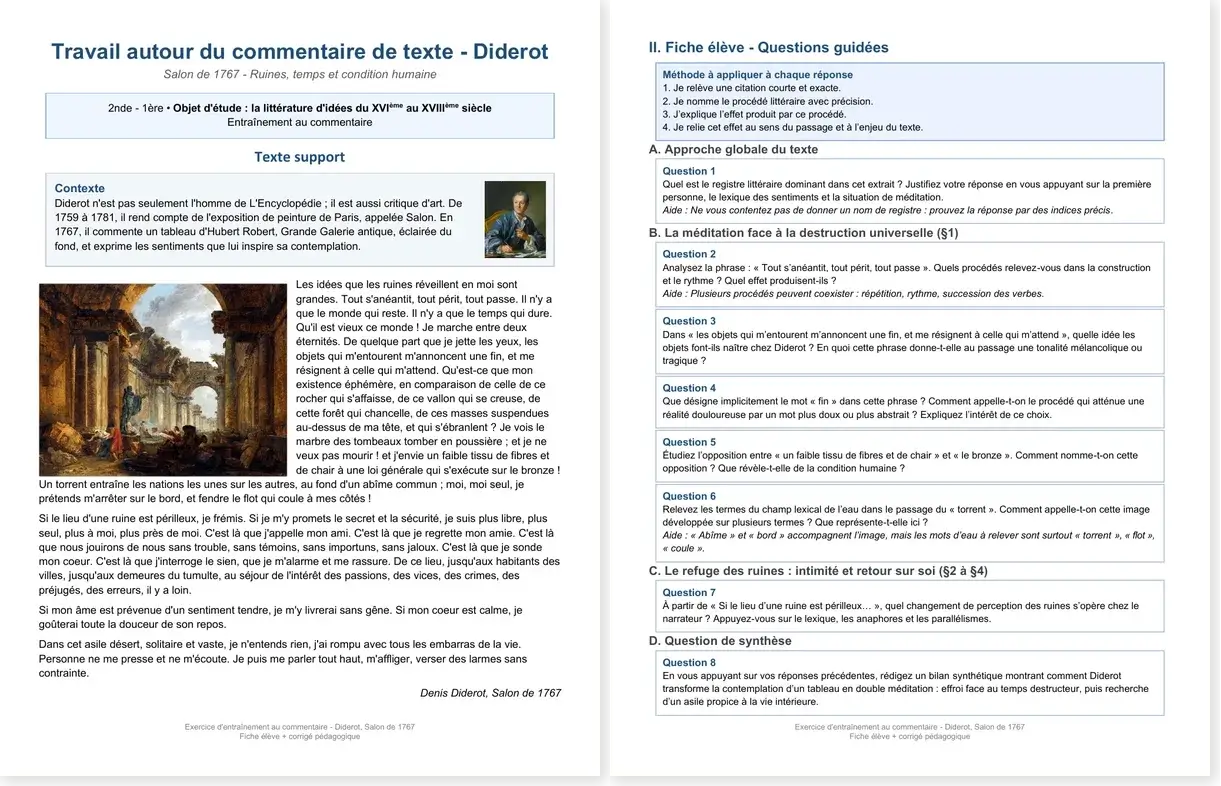
This new exercise focuses on an excerpt from Diderot’s Salon de 1767. It helps students understand how the contemplation of ruins becomes a reflection on time, disappearance and the human condition.
📎 Diderot worksheet content ▼
-
An excerpt on ruins The text makes it possible to analyse the shift from aesthetic description to philosophical meditation.
-
A reflection on time Students work on disappearance, the human condition, memory and the relationship between landscape and thought.
-
A detailed pedagogical answer key 6 pages of detailed correction to guide students towards more precise analysis, with formulations that can be used in a commentary.
🎯 What students learn with Diderot ▼
Understand how an observed object triggers an intimate and philosophical reflection.
Show that the ruins are not merely decorative, but become signs of time.
Move from identifying techniques to writing a genuinely useful interpretive sentence.
Practise commenting on an argumentative or reflective text and building a personal reading of the passage.
📥 Download the free watermarked PDF – Diderot
Free version of the pedagogical answer key, with watermarks, ready to view or print.
🔒 Clean PDF + editable DOCX – Diderot
The premium versions include the watermark-free PDF and the editable Word file.
❓ Frequently asked questions
Are these exercises suitable for the French Baccalaureate?
Yes. They are designed to train students in literary analysis, outline building and literary commentary writing.
What level are these worksheets for?
They are mainly suitable for Grade 11 students, but they can also be used in Grade 10 to introduce literary commentary methodology step by step.
Is the Diderot document free?
A watermarked PDF version is available for free. The clean PDF and editable DOCX versions are reserved for premium members.
Why offer a DOCX version as well?
The DOCX format allows teachers to edit the instructions, adapt the level of difficulty or customise the answer key.