From French Slang to Standard: Transforming Sentences
il est trop chelou, elle a la patate: thirty real-life sentences in colloquial and vulgar French that students rewrite in proper, standard French, with a detailed answer key.
The perfect companion to our registers of language worksheet. The correction goes beyond the answers, with usage notes: why you should avoid putain, why débile is disrespectful, what à la ramasse really means.
What students practise
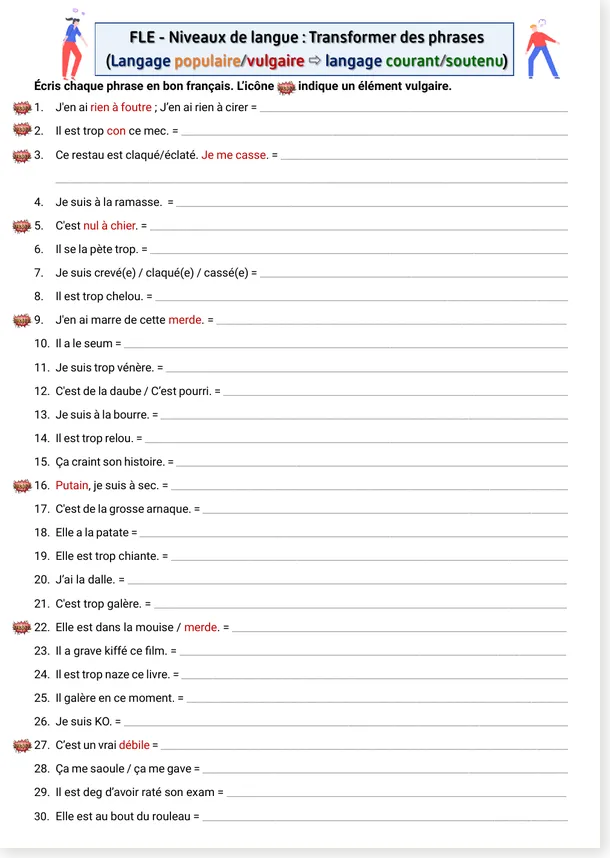
Each line gives a sentence heard in the street: students identify the register, spot the colloquial or vulgar element (marked with an icon when it is vulgar), then rewrite the whole sentence in standard French: je suis crevé becomes je suis très fatigué, c’est trop galère becomes c’est très compliqué.
And the answer key doubles as a mini dictionary of slang: le seum, chelou, la daube, être à la bourre… with notes on register and context, because one expression can carry several meanings: à la ramasse means dépassé or épuisé depending on the situation.
Read the sentence and spot the colloquial or vulgar element.
Rewrite the whole sentence in standard, correct French.
Compare with the answer key and its model sentences.
Read the usage notes: putain becomes purée, débile is best avoided, KO comes from knocked out.
A taste of the slang
Twelve of the thirty expressions, with their standard French equivalent:
🎮 Interactive quiz: can you guess the meaning?
This quiz picks ten words and expressions from the worksheet. The idea is simple: guess the meaning, then check your score at the end. A perfect warm-up before starting the rewriting task.
💬 Open the slang vocabulary quiz⌄
Click on the answer you think is correct. Green means right, red means wrong, and the correct answer is always shown in green. You can try again as many times as you like.
1. What does être crevé mean?
2. A galère situation is…
3. Someone who is relou is…
4. Vénère means…
5. To kiffer something means…
6. Avoir le seum means…
7. C’est naze means…
8. C’est chiant, in proper French, becomes…
9. Je suis à la bourre means…
10. Il est trop chelou means…
Download the worksheet
One page of sentences plus a full answer key with usage notes. The DOCX lets you select the sentences that fit your group.
Preview: 30 sentences, vulgar elements flagged with an icon
Recommended level
Frequently asked questions
What level is this worksheet for?
Mainly B1-B2: the colloquial and vulgar vocabulary stretches learners beyond textbook French, while the rewriting task stays accessible.
What is the task exactly?
Students rewrite 30 colloquial or vulgar sentences in standard French: je suis crevé becomes je suis très fatigué, c’est trop galère becomes c’est très compliqué, and so on.
Is there an answer key?
Yes, a full answer key with model sentences and usage notes: register, context, and words to avoid or replace, like putain or débile.
Is it appropriate for the classroom?
The vulgar elements are flagged with an icon so teachers can preview and select. The goal of the worksheet is precisely to move from vulgar or colloquial French to correct, standard French.
Is the worksheet free?
No. The PDF and the editable DOCX are reserved for Premium members.