What About TV? French Text Analysis and Argumentative Structure
A clear, two-page worksheet that helps high-school students analyse a French argumentative text about television, advertising and children’s choices.
The activity combines close reading, logical connectors, argument mapping and a short written summary.
🔎 Worksheet at a glance
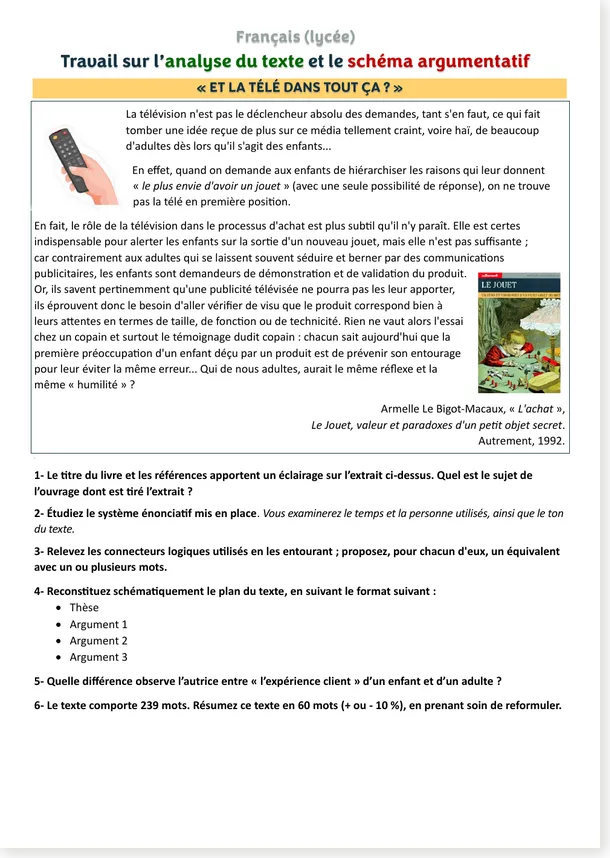
The source text questions the idea that television is the main reason children want a toy. It argues that children also need to see a demonstration, test the product and hear the opinions of friends. This concrete topic makes the argument accessible while allowing students to practise formal text analysis.
Armelle Le Bigot-Macaux, « L’achat », in Le Jouet, valeur et paradoxes d’un petit objet secret (Autrement, 1992).
✍️ The six tasks, precisely explained
🎓 Benefits for learners and teachers
Develop a reliable method for analysing argumentative prose; distinguish a thesis from its supporting arguments; expand the vocabulary of logical relations; and practise a demanding, measurable summary task. The correction also models concise, evidence-based answers.
Use one compact document to assess reading, language analysis, argument mapping and written synthesis. The editable DOCX makes it easy to remove the correction, adjust the expected word count, simplify selected questions or create a timed assessment.
📖 Essential analytical terms
Open the terminology guide ▼
⬇️ Preview and download
Page 1 contains the text and six tasks. Page 2 contains the complete correction, including the argumentative plan and a model summary.
Free High-School French Text Analysis – PDF
Download the print-ready A4 worksheet with the source text, six analytical tasks and full correction.
🔒 Editable DOCX – Premium access
Unlock the Word version to adapt the instructions, questions, summary requirement and correction.
❓ Frequently asked questions
What level is this worksheet? ▼
It is designed for French high-school classes. As a CEFR guide, it is most suitable for strong B1 to B2 learners because it requires both detailed comprehension and metalanguage for analysing discourse.
What exactly do students have to do? ▼
They identify the source topic, analyse the enunciative system, study logical connectors, reconstruct the thesis and three arguments, compare child and adult customer experience, and write a 60-word summary.
Is a complete answer key included? ▼
Yes. Page two provides answers to all six tasks, suggested equivalents for the connectors, a complete argumentative plan and a 65-word model summary that respects the stated tolerance.
Can teachers edit the resource? ▼
Yes. Premium members can download the editable DOCX and adapt the prompts, layout, expected summary length or correction.
Is this a free worksheet? ▼
The complete PDF and answer key are free to download. The editable DOCX is reserved for Premium members.
Where does the source passage come from? ▼
It is an excerpt from Armelle Le Bigot-Macaux’s chapter « L’achat » in Le Jouet, valeur et paradoxes d’un petit objet secret, published by Autrement in 1992.