🧰 English A2 · Reading, speaking and writing · Unusual occupations
Unusual Jobs Worksheet: Would You Try Them? (A2)
Would you taste pet food, test furniture or collect snake venom for a living? This Unusual Jobs worksheet introduces five surprising occupations and asks students to read closely, compare information and explain their choices in English.
The new three-page A2 resource combines short job descriptions, vocabulary support, reading questions, a partner discussion and a guided writing task. A separate teacher’s answer key provides corrections and model responses.
Try the older one-page Weird Jobs PDF for free, or choose the expanded Premium version in A4 or US Letter.
Get the free original PDF ↓ Explore the new Premium version →
🎯 What students practise
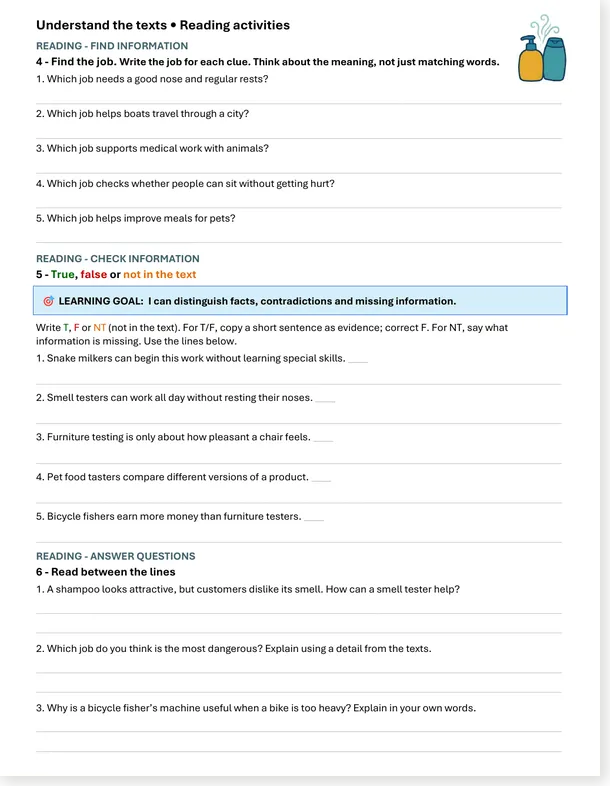
The new worksheet moves beyond finding a familiar word in a text. Students identify jobs from meaning, distinguish false statements from missing information and support their answers with evidence. They then use the same ideas in speaking and writing.
Observe five pictures, name objects or animals and guess the jobs.
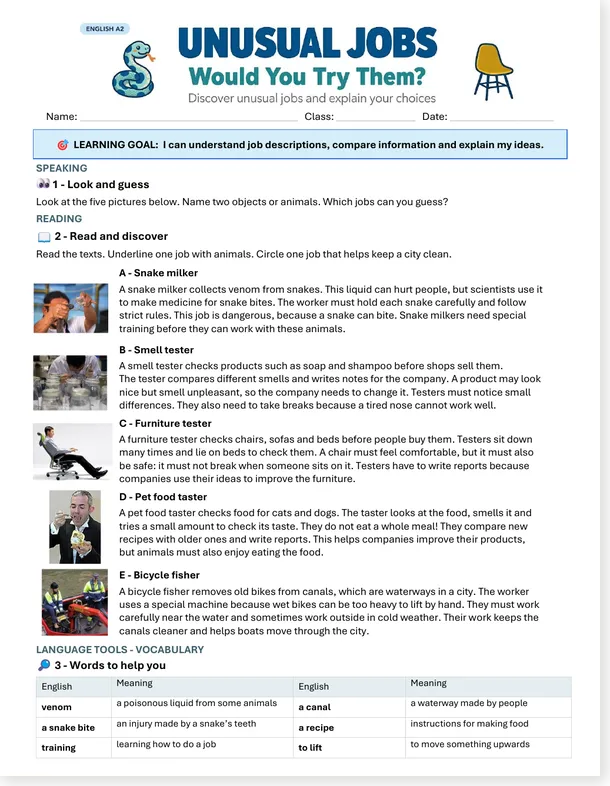
Read five portraits and use the six-entry vocabulary table for support.
Choose jobs you would or would not like to try and explain why.
Write 6–7 sentences, give reasons and compare two jobs.
🧰 Meet five unusual occupations
Each short portrait explains what the worker does, why the job is useful and what it requires.
Collects venom used in medical work. The portrait introduces danger, careful handling and special training.
Compares the smells of products such as soap and shampoo and reports differences to a company.
Tests chairs, sofas and beds for comfort and safety, then writes reports.
Checks pet food, compares recipes and helps improve products for cats and dogs.
Removes old bicycles from canals with special equipment to help keep waterways clear.
📖 Three pages with nine numbered sections
Picture-based speaking warm-up, five short texts, a reading instruction and a vocabulary table.
Five job-identification clues, five true/false/not-in-the-text statements and three questions requiring explanation or inference.
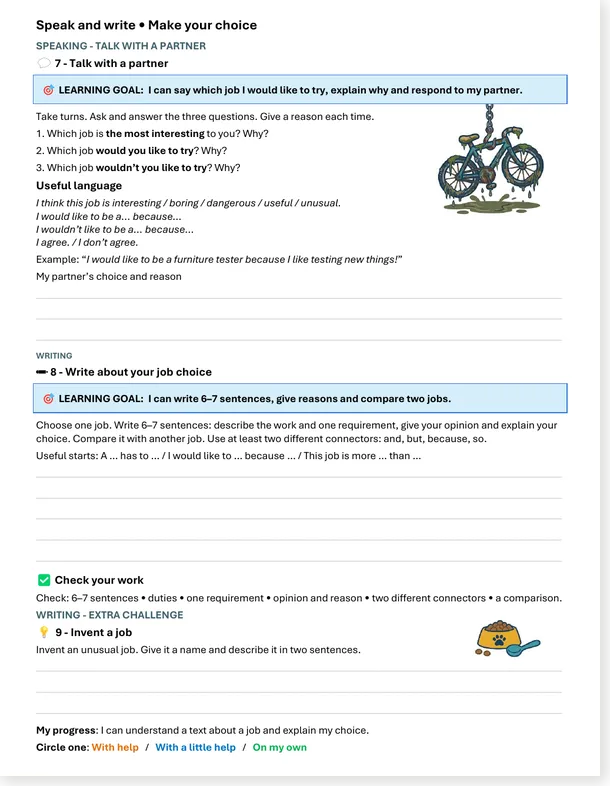
Three partner questions, space to record a partner’s choice, a 6–7-sentence writing task, an invented-job challenge and self-assessment.
💬 Give an opinion, a reason and a comparison
The speaking task asks students which job interests them, which they would like to try and which they would avoid. Sentence starters support turn-taking and responses to a partner.
For the writing task, students describe a job and one requirement, explain their opinion and compare it with another occupation. They use at least two different connectors from and, but, because and so. A checklist helps them review their 6–7 sentences.
🎁 Download the free original Weird Jobs worksheet
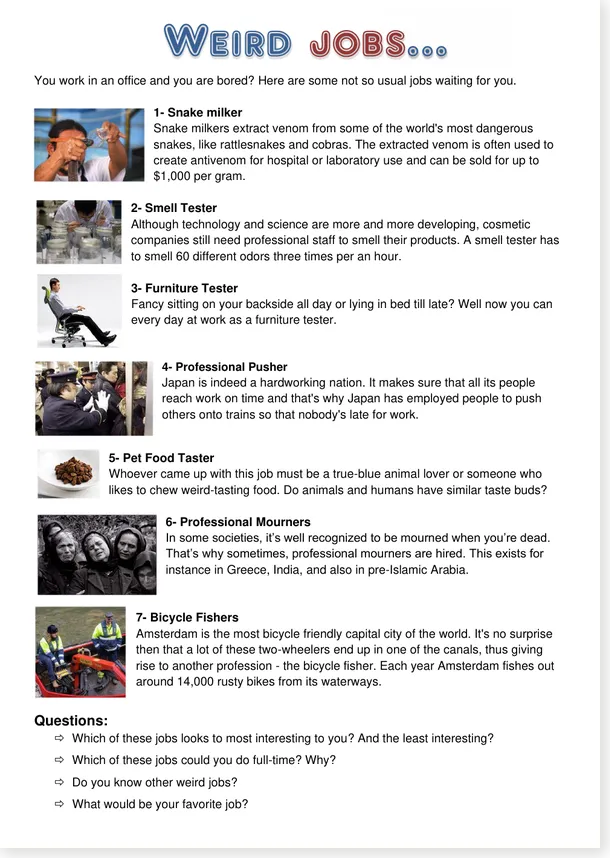
The older version is a one-page A4 PDF with seven job descriptions and four open questions for discussion. It includes the five occupations featured in the new version, plus professional pushers and professional mourners.
Choose it for a shorter reading and discussion activity. Its original texts use some less familiar expressions; the newer edition provides more structured A2 support and a fuller sequence of tasks.
📄 Free original PDF — A4
The older one-page reading and discussion worksheet.
📥 Download the new Premium Unusual Jobs worksheet
The expanded three-page A2 edition is available as a PDF in A4 and US Letter, plus an editable US Letter DOCX. The separate four-page teacher’s answer key includes evidence, corrections and model speaking and writing responses.
🎓 Recommended English level and school grades
ESL/EFL: A2. The new edition provides vocabulary definitions, sentence starters and a writing checklist. Some groups may need help with the inference questions and comparisons. It can suit teenagers and adult learners as well as younger students; choose by proficiency rather than age alone.
For native English speakers: suggested for approximately ages 9–12, with the reading used as a starting point for discussion, evidence-based answers and writing.
Grades 4–6.
Years 5–7.
Years 4–6.
These are teaching recommendations, not official curriculum alignments. Native readers may find the short texts straightforward; extend the task by asking them to justify choices, challenge assumptions and develop their comparisons.
💡 Ideas for using the worksheet in class
Start with the pictures and collect guesses before revealing the job names. During reading, ask pairs to identify the duty and one requirement in each portrait. After correction, use the partner task to rehearse ideas before students write independently.
When checking open answers, focus on whether learners support their ideas with relevant details. Different job choices are welcome: the aim is to explain a choice clearly, not to agree on the best occupation.
📚 More English activities to build descriptions and opinions
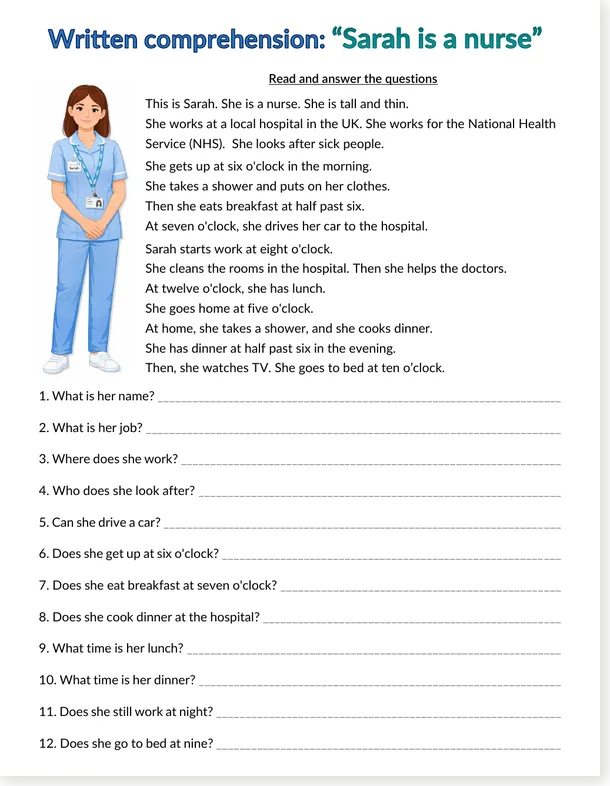
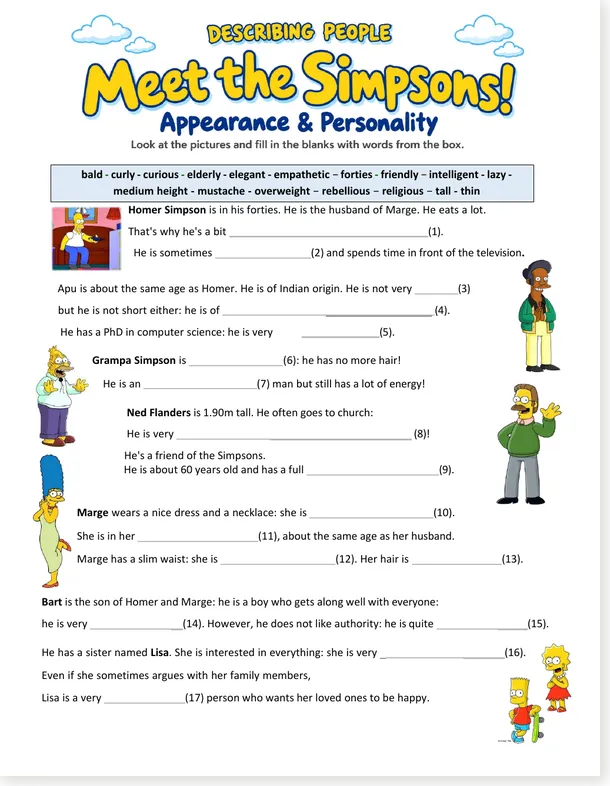
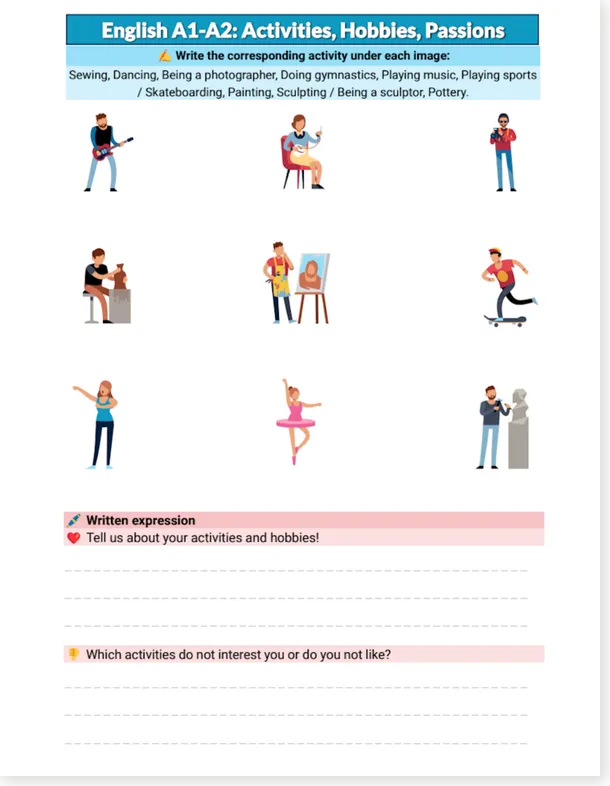
Find more reading, vocabulary and writing activities in our English worksheets collection.
❓ Frequently asked questions
Which version is free?
The original one-page Weird Jobs A4 PDF is free. It contains seven occupations and four discussion questions.
What is included in the Premium version?
A three-page A2 student worksheet with five portraits, reading tasks, partner speaking, guided writing and an extra challenge. The teacher’s answer key is a separate PDF.
Is the new edition simply a redesign?
No. It focuses on five jobs and adds a structured learning sequence, vocabulary definitions, evidence-based comprehension, partner interaction and a 6–7-sentence writing task.
What level is it for?
The new version is designed for A2 English learners. For native speakers, Grades 4–6 are a suggested range, with discussion and writing extensions as needed.
Can I edit the worksheet?
Yes. Premium members can download the editable US Letter DOCX supplied on this page.
Does the answer key give only fixed answers?
No. It includes corrections for the reading tasks and model responses for speaking and writing. Relevant, supported alternatives are welcome for open-ended questions.