English · Describing people · Vocabulary in context
The Simpsons: Adjectives and Physical Description Worksheet (Free PDF)
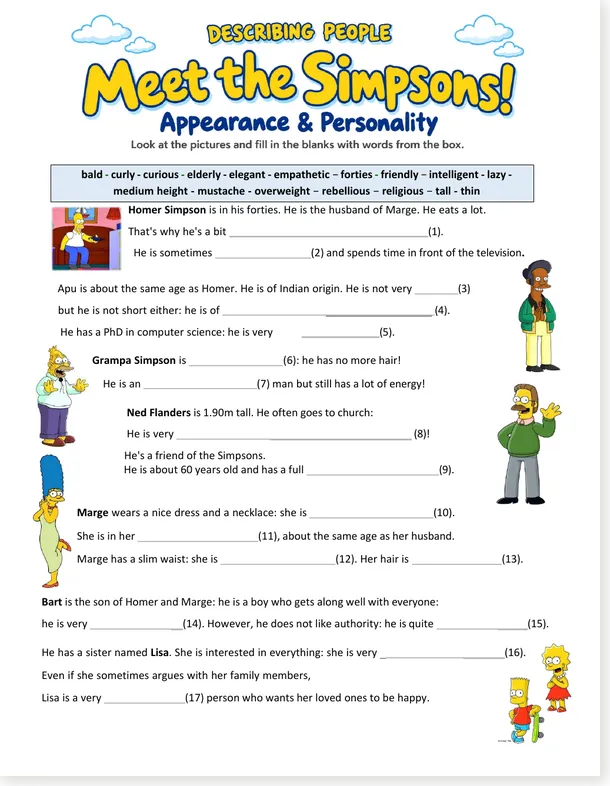
Practise describing people in English with this free Simpsons worksheet. Students use a word bank to complete 17 gaps in short portraits of Homer, Marge, Bart, Lisa, Grampa, Apu and Ned Flanders. The activity combines vocabulary for physical appearance, personality and age with clues in each description.
The A4 and US Letter PDFs are free and include the activity and its answer key. Editable Word versions are available to Premium members.
What students practise
What does a character look like? What are they like? This activity brings both questions together. Students choose words describing build, hair, age and personality. Familiar characters provide a starting point, while the written clues help learners decide.
Read the word bank and the seven portraits.
Look for details about appearance, habits and behaviour.
Choose the word or expression that fits each gap.
Compare answers and explain which clues helped.
Physical appearance, personality and age vocabulary
The word bank contains 17 items. Alongside adjectives, students meet a noun and expressions used in descriptions, such as a mustache, of medium height and in his forties.
Bald, curly, tall, thin, overweight, medium height and mustache: vocabulary for hair, height, build and facial hair.
Curious, empathetic, friendly, intelligent, lazy, rebellious and religious: words connected to clues in the portraits.
Elderly, forties and elegant: words for talking about age and describing someone’s appearance or style.
Seven characters, 17 missing words
The descriptions cover Homer, Apu, Grampa, Ned Flanders, Marge, Bart and Lisa. Learners connect the details in each portrait to the word bank: someone interested in everything is curious; someone who dislikes authority is rebellious.
The task encourages students to read beyond the gap. A character’s habits or qualifications can provide the clue needed to complete the next sentence.
Download the free Simpsons worksheet PDF
Choose A4 or US Letter for printing. Both PDFs include the gap-fill activity and its answer key.
Free PDF — A4
The printable activity and answer key in A4 format.
Free PDF — US Letter
The same activity and answer key, sized for 8.5 × 11-inch paper.
Answer key
A corrected version is included in the worksheet. You can also check the answers below.
Open the 17 answers
- overweight
- lazy
- tall
- medium height
- intelligent
- bald
- elderly
- religious
- mustache
- elegant
- forties
- thin
- curly
- friendly
- rebellious
- curious
- empathetic
Ideas for using the worksheet in class
Ask learners to name the characters and suggest words to describe them. Introduce unfamiliar items from the word bank.
Ask pairs to compare answers and underline the clues supporting their choices before checking the corrected version.
Invite students to write a short portrait of another fictional character. Classmates read the description and guess who it is.
Recommended level and school grades
For ESL/EFL learners: suggested level A2, with support for less familiar vocabulary. Choose by English proficiency rather than school grade; the worksheet can also be used with older beginners.
For native English speakers: suggested for upper elementary vocabulary practice, approximately ages 9–12. These are teaching recommendations, not official curriculum alignments.
Grades 4–6: describing characters, using context clues and discussing vocabulary choices.
Years 5–7: upper primary to early secondary vocabulary practice. Year names differ elsewhere in the UK.
Years 4–6: appearance and personality vocabulary, with a short character-writing extension.
For native speakers, the gap-fill task is relatively straightforward; extend it by asking learners to justify their answers or write a new character portrait.
More worksheets for describing characters
Keep practising descriptions, then expand a character portrait with interests or an original creation.


Frequently asked questions
What does this worksheet contain?
A 17-item word bank and short portraits of seven characters. Students complete 17 gaps using vocabulary for appearance, personality, age and style. A corrected version is included.
Is the PDF free?
Yes. The A4 and US Letter PDFs are free and include the exercise and answer key. Editable DOCX versions are for Premium members.
What English level is it suitable for?
For ESL/EFL learners, A2 is a suggested starting point. For native English speakers, suggested grades are US/Canada Grades 4–6, England Years 5–7 and Australia Years 4–6. Adjust support and extension tasks to your class.
Do students need to know The Simpsons?
Knowing the characters can help, but the written descriptions provide clues for choosing the missing words. Students can work from the text.
Can I edit the worksheet?
Premium members can download the A4 and US Letter DOCX files to adjust the vocabulary, descriptions or layout.