Bisphenol: An Invisible and Omnipresent Danger 🧪
In our bottles, our cans, our receipts and even our baby bottles: the bisphenol is everywhere, and it is dangerous for the health. This worksheet makes students read a real press-style article, with the scandal of 2010, the Que Choisir magazine and the association CHEM Trust.
Two complete versions, A2-B1 and B2-C1, with the same topic but a richer text and more tasks at the higher level. And a free abridged version to try the activity in class. Vocabulary, comprehension, conjugation and writing, all in one document.
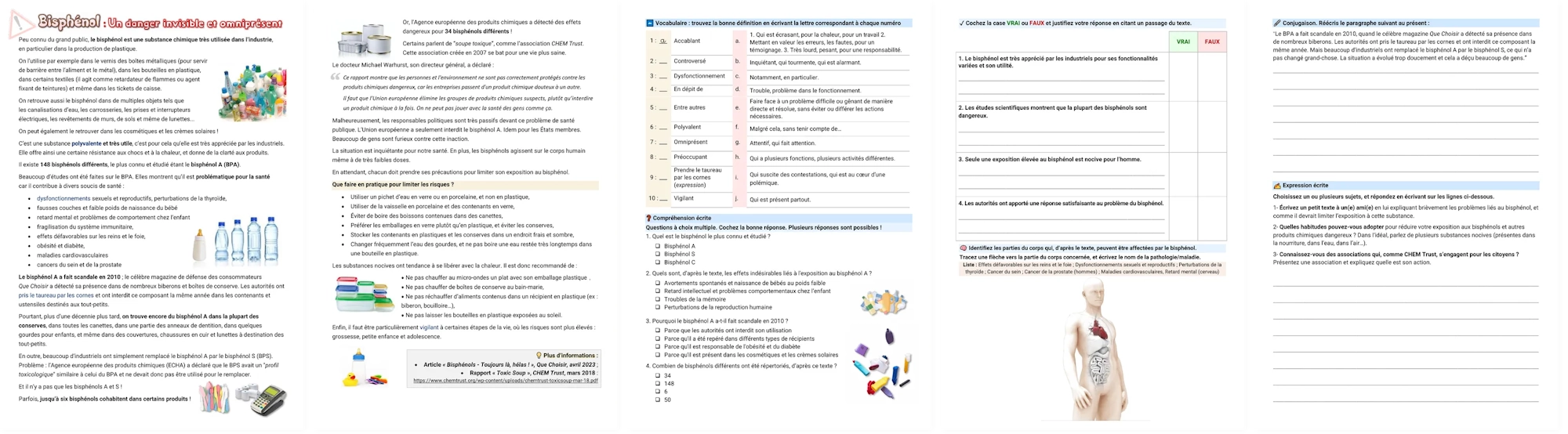
The article, the vocabulary, the comprehension tasks and the writing, with the answer key
✨ What students practise
First, the reading: where is the bisphenol? why do the industries use it? why is it a problem? The text is clear, with real sources (the ECHA, Que Choisir, the doctor Michael Warhurst). Then the students answer the questions: multiple choice, true or false with a quote from the text, and the body parts affected.
After, they work on the language: ten or fifteen definitions to match, a paragraph to rewrite in the present, and a writing task. In short, a complete session of French, on a topic that concerns everybody.
Read the article: the objects, the risks, the scandal, the inaction of the authorities.
Answer the multiple choice and the true or false, with a quote from the text.
Match the definitions, place the diseases on the body, rewrite the paragraph in the present.
Write to a friend, share your habits, or present an association.
📚 Two levels, one topic
The same article, adapted for two levels, plus a free abridged version:
A clear text, 10 definitions, 4 multiple choice questions, true or false, the body parts, the conjugation and the writing, with the answer key.
A richer text (altérations, retards cognitifs, indignation), 15 definitions, 5 questions, justified true or false and three writing topics.
The text, the 10 definitions and the multiple choice, with the answers. Perfect to try the activity before going Premium.
💬 The words of the article
The main vocabulary, with the English equivalent:
📰 The French consumer magazines
The article quotes Que Choisir, a magazine the students will find interesting to know about: it has been fighting for French consumers for more than seventy years. And it mentions the ECHA, the European agency. But France used to have a second major magazine, 60 millions de consommateurs, whose fate is a lesson in itself about public policies.
✅ Que Choisir (Que Choisir Ensemble)
Created in 1951, this non-profit association defends consumers in complete independence, without public subsidies. It tests products, publishes investigations, and has local branches all over France to help people with their litigations. In 2010, it was Que Choisir that detected bisphenol A in many baby bottles and cans, and triggered the scandal. The magazine is still published today and its website is a great resource: quechoisir.org.
⚠️ 60 millions de consommateurs
The other major French consumer magazine was published by the Institut national de la consommation (INC), a public body. But the INC was liquidated in March 2025, as part of the 2026 budget. The future of the magazine now depends on finding a private buyer. This matter is interesting for the students: It is a concrete example of how a public service can disappear in a few years, and why independent associations like Que Choisir matter.
🎁 The free abridged version
The text, the 10 definitions and the multiple choice questions, with the answers. A good way to see if the topic works with your group.
🎁 Free PDF – abridged version
The text, the vocabulary and the multiple choice, with the answers.
🎁 Free DOCX – abridged version
The same abridged version, editable, to adapt the text if you need.
🔓 Want the complete versions?
Become a Premium member to unlock the full A2-B1 and B2-C1 worksheets.
💎 The complete versions (Premium)
All the tasks, all the answers, and two levels to choose from. Ready to use in class.
Preview: the article and all the tasks, with the answer key
🎯 Recommended level

❓ Frequently asked questions
📚 What level is this worksheet for?
There are two complete versions: A2-B1 and B2-C1. The abridged free version is at the A2-B1 level.
🗂️ What does the complete version contain?
The article, the vocabulary definitions, multiple choice questions, true or false with justification, the body parts to complete, a conjugation task and writing topics, with the answer key.
🧪 What is the article about?
The bisphenol: where it is, why the industries use it, why it is dangerous, the scandal of 2010, and what we can do to limit the exposure.
🎁 Which version is free?
The abridged version, in PDF and DOCX: the text, the 10 definitions and the multiple choice, with the answers. The complete versions are for Premium members.
🗣️ Can I use it for a discussion?
Yes, the topic is perfect for that: the writing tasks ask about the daily habits and the associations, and the article opens a debate on the inaction of the authorities.