19 Everyday French Verbs: Vocabulary and Conjugation Worksheet
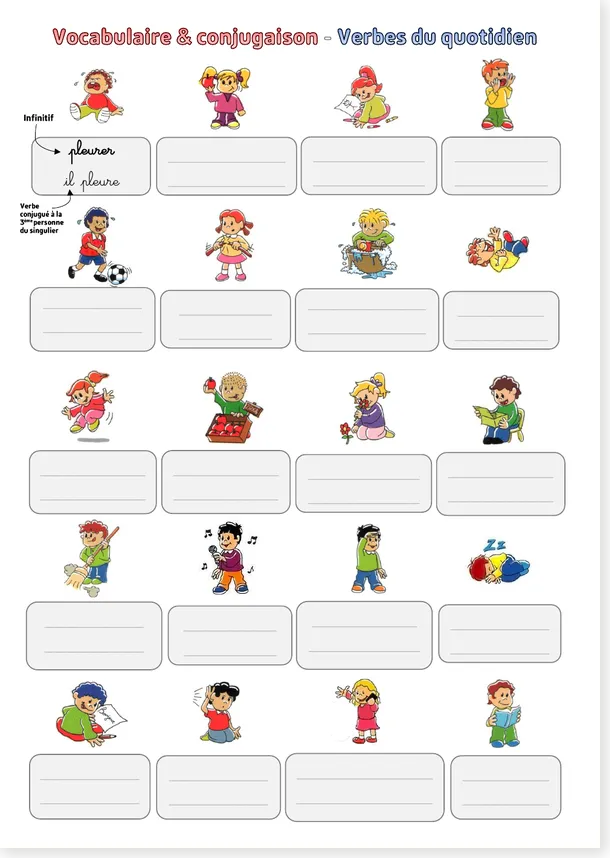
Twenty pictures of daily actions, from pleurer to vendre: students identify each verb, write it in the infinitive, then conjugate it in the third person singular, il or elle. A simple routine that builds both vocabulary and present-tense confidence.
The free preview gives the first page with a watermark. Premium members get the complete worksheet with printable labels (infinitive + conjugated form) in PDF, plus an editable DOCX.
What students practise
For each picture, students write two lines: the infinitive of the verb, then the verb conjugated in the third person singular. The first picture is done for them, pleurer, il pleure, so the routine is clear from the start.
Most verbs are regular -er verbs (chanter, laver, manger, téléphoner…), which builds confidence, while seven frequent third-group verbs add just the right challenge: dormir, écrire, lire, ouvrir, rire, sentir and vendre.
Observe the picture and identify the action: who does what?
Write the infinitive of the verb on the first line.
Conjugate it in the third person singular: il or elle, depending on the picture.
Use the premium labels as a word bank, a cut-and-match game or an answer key.
The 19 verbs at a glance
Every verb on the worksheet, with its third person singular and English meaning:
Try the first page for free
The free preview shows page 1 with a watermark: twenty pictures, the example and the writing lines.
Free preview – page 1
20 pictures with the example, ready to print.
Recommended level
Frequently asked questions
What is the task exactly?
For each of the twenty pictures, students write the infinitive of the verb, then conjugate it in the third person singular, il or elle.
Which verbs are covered?
Nineteen everyday verbs: twelve regular -er verbs plus seven frequent third-group verbs, dormir, écrire, lire, ouvrir, rire, sentir and vendre. The example is pleurer, il pleure.
What are the labels for?
Each label gives the infinitive and the conjugated form. They work as a word bank for support, a cut-and-match activity for younger groups, or an answer key for quick correction.
What is free and what is premium?
The watermarked first page is free. The complete worksheet, the labels and the editable DOCX are reserved for Premium members.
How can I extend the activity orally?
Point at a picture and ask: Qu’est-ce qu’il fait ? Il lave la voiture. Students can also mime an action and let the class guess the verb.