Passé Composé Practice: 13 Sentences to Conjugate ✍️
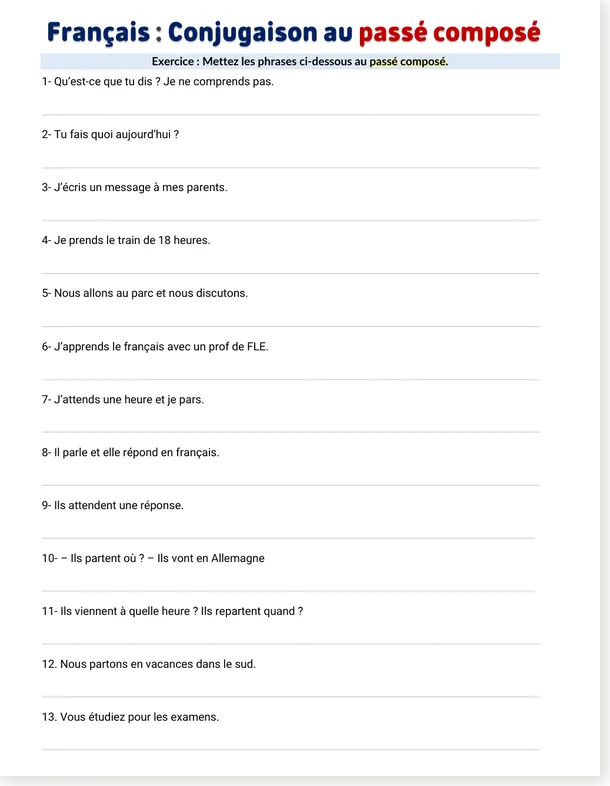
Thirteen sentences in the present tense to transform into the passé composé. « J’écris un message » becomes « J’ai écrit un message », « Nous allons au parc » becomes « Nous sommes allés au parc ». The exercise mixes both auxiliaries: avoir for most verbs, être for the movement verbs (aller, partir, venir, repartir).
The complete answer key is printed on the worksheet itself: the thirteen corrected sentences, with the past participle agreements shown. The A4 PDF with watermark is free for everybody; the clean PDFs and the editable DOCX files are for Premium members.
✨ What students practise
Three things, in order: 1) choosing the right auxiliary — avoir or être; 2) forming the past participle — regular for étudier → étudié, irregular for dire → dit, faire → fait, écrire → écrit, prendre → pris; 3) the agreement with être — « nous sommes allé(e)s », « ils sont partis ».
Thirteen sentences are enough to cover every case without the exercise becoming too long: irregular participles, the two auxiliaries, the agreements, and even the sentences with two verbs (sentence 5, sentence 7, sentence 11). The answer key on the worksheet allows self-correction at home.
Read the present sentence and identify the verb or the two verbs.
Pick the auxiliary: avoir, or être for the movement verbs.
Conjugate the auxiliary in the present and add the past participle.
With être, make the participle agree with the subject. Then check with the corrigé.
🔀 The 13 sentences, with the answers
Present on the left, passé composé on the right — the complete correction, for the teacher or for a self-check at home:
🧠 The grammar in three cards
Most verbs conjugate with avoir: dire, faire, écrire, prendre, apprendre, attendre, répondre, étudier. No agreement of the participle here.
The movement verbs go with être: aller, partir, venir, repartir. « Nous sommes allés », « elle est venue », « ils sont repartis ».
With être, the past participle agrees with the subject: allé, allée, allés, allées. The little letter in brackets on the worksheet is there for that.
🎁 The free version, with watermark
The 13 sentences and the corrigé, in A4, with our watermark.
🎁 Free PDF – A4, with watermark
The 13 sentences with the answer key, free for everyone.
🔓 Want the clean PDFs and the DOCX files?
Become a Premium member to unlock the clean A4 and US Letter versions, plus the editable Word files.
💎 The clean versions (Premium)
The same worksheet without watermark, in A4 and US Letter, plus the DOCX files to change the sentences, the verbs or the order — useful to build your own versions for each class.
Preview: the 13 sentences and the corrigé
🎯 Recommended level, and the next steps


❓ Frequently asked questions
📚 What level is this worksheet for?
Mainly A2-B1: the sentences are short and familiar, but the mix of auxiliaries and the agreements make it a real A2+ task. Perfect for a B1 revision too.
🗂️ What does the worksheet contain?
Thirteen present-tense sentences to transform into the passé composé, with writing lines, and the complete corrigé printed on the second part of the page.
🔀 Which auxiliaries are practised?
Both: avoir for most verbs (dire, faire, écrire, prendre, apprendre, attendre, répondre, étudier) and être for the movement verbs (aller, partir, venir, repartir), with the agreement of the participle.
🎁 Which version is free?
The A4 PDF with watermark is free for everybody. The clean A4 and US Letter PDFs and the editable DOCX files are reserved for Premium members.
🔑 Is there an answer key?
Yes, the full corrigé is printed on the worksheet itself: the thirteen sentences conjugated, with the agreements shown — ideal for a quick correction or for self-study.